Monday, January 2, 2017

Week 1: 15 December 2016

We arrived on 15 December 2016 to an empty research station. The usual tasks awaited: unpacking and setting up the lab, moving into our room, and walking around to locate iguanas. This trip I would be assisted by my husband for 2 weeks; afterwards I'm on my own. The pressure felt immense to get everything accomplished before he left as well as enjoy Palo Verde and all its beauty.

With 30 Encounternet proximity tags, I decided to use 25 leaving a few for back up. Below is Yellow-Yellow-Blue re-beaded at the neck with her proximity tag attached. (She' none too happy about even gentle human handling; when else would she be restrained?)

With each capture, besides morphometric measurements, making sure I had a blood sample, replacing neck beads, and attaching a proximity tag, I also ran a personality assay, seeing how much movement an iguana would undertake in an arena with a predator replica.

Palo Verde OTS staff built m an arena with door that nicely fits my trap, as well as a ladder on which to mount a video camera. It works perfectly for my needs!

Trapping, tagging, and testing 25 animals went well -- we were done in a mere 5 days. And then, well, you know what happens in field work....


Friday, December 9, 2016

Field Season I: December 2016-March 2017

Male C. similis wearing an Encounternet tag.

It is almost time to return to Palo Verde, to warm weather and the dry tropics, to Ctenosaura similis research, and to all the joys and frustrations of field work.

GGG enjoying dappled sunlight.
Following the successful trial of the Encounternet System in Spring 2016 on nine lizards, I'll be tagging ~25 animals this tip to understand their social network structure and how certain drivers may contribute to who socializes with whom. Is it based on genetic relatedness? Are physical 'neighbors' increasingly social compared to more distant group members? Do bold animals prefer other bold lizards or are 'besties' occurring between different personality types?

In the first few weeks, my task is to trap 25 animals and collect morphometric measurements to understand current body condition and overall health. Iguanas are favorably inclined to enter a humane trap for fruit, so this part is not too difficult.

Once measurements are taken, I'll make sure the animal is PIT tagged, take a small blood sample if needed, and attached a solar Encounternet tag.

I then will evaluate the lizard in a personality test for neophilia/neophobia. In an 3 sq. meter wood box outfitted with a plastic raptor reminiscent of natural predators, I'll let each iguana explore for 5 minutes, digitally recording their every move (or lack thereof!) for future analysis. Bolder animals should explore more of the box and be more willing to approach the plastic raptor compared to shy conspecifics.

In between trapping animals and behavioral testing, I'll be setting up base stations to collect data stored on the Encounternet tags and checking that everything works. Once all 25 lizards are trapped, tagged, and tested, the system can go live and eight weeks of data collection begins!

I feel fortunate to work at the OTS Palo Verde Research Station, in a country as beautiful as Costa Rica. Of course, research is always only possible with the help of so many others -- the School of Biological Sciences at the University of Northern Colorado, and the ever gracious and seriously invaluable staff at PV OTS. Here's to a great season of lizard social research!


Saturday, March 5, 2016

WOG (White-Green-Orange) returns!

WOG: thin and home

White-Orange-Green, known simply as WOG, was first trapped and beaded in March 2013. A bold animal, she used refugia in the Big Tree area of the research station. WOG will park herself ~1.5 meters from a human, observing them as they observe her. She's an instructive and enriching element of my work.

WOG was part of the group selected to help calibrate the Encounternet tags. She wore #9, providing physical proximity data from 5 February 2016 to 24 February 2016 when I observed her walk across the Big Tree lawn, head down the hill, traverse the road, and disappear. She wasn't interacting with other tagged animals; we couldn't get any radio signal from her tag at all.

Truthfully, we felt all the while that she'd gone off to lay her eggs, as every other female in our group has also left and returned or is still out. (We are locating Yellow-Yellow-Orange on a daily basis as she does trail digs at various nests.) On 4 March 2016 WOG was sighted on the sidewalk right above one of her usual refugia -- thinner, having obviously laid her eggs -- and her Encounternet tag was gone.

We don't have much hope of finding her tag -- if undergound, we won't get a decent signal and it will eventually run out of power. Further, the nests are conglomerations of branches from a main opening, used by multiple animals at the same time, open and closed even on a daily basis and female after female may use the same spot. In other words, a needle in a haystack! 

Yes, how incredible is it that year after year, WOG has likely performed the same fascinating behavior -- leaving her daily home range with known refugia, travelling several hundred meters to a nesting site, only to come home to the same place. And she is not the only female we are observing completing this process -- White-White-Brown and Yellow-Brown-White have done the same thing and we hope Pale Blue-Black-Red and Red-Pale Blue-Pale Blue will soon head back home.
Iguana nest with tail drags

Tuesday, March 1, 2016

Where have all the 'guanas gone? Long time passing.....


Solar Encounternet tag.
Once upon a time, a calibration study commenced. A small group of interacting Ctenosaura similis were chosen to sport solar tags that received and transmitted signals when animals encountered each other.

Thin Yellow-Brown-White after laying her eggs.
The scientists hoped they would wear the tags for about 6 weeks, after which they would be removed. In the beginning, all was well. But slowly, females in the study disappeared. Their radio signal strength indicators weakened and simply seemed to stop working.

Troubleshooting was impossible with no signal. Suddenly, female iguanas with no beads and no solar tags began nesting everywhere -- along the old airstrip, along the slope of the football field, in a dirt mound, in open areas of tilled soil.

Soon, a missing tagged iguana re-appeared, thinner, but behaving normally. Then the second missing iguana came home, also skinny. Between these two events, two other females left the study. By now it was obvious to the scientists that iguanas were laying eggs a bit earlier than reported in the literature.

Study males decamped from their breeding territory and seemed uninterested in pursuing copulations. Younger and smaller iguanas appeared, in crevices and on walls, potentially joining their larger adult counterparts. The social system was in flux.

Lighter brown soil of iguana nesting area.

C. similis head appearing out of nesting burrow.
Green iguanas, Spiny-Tailed Iguanas -- everyone was laying eggs, moving, closing down this chapter and readying for the new one.


Friday, February 26, 2016

White-White-Brown Returns!

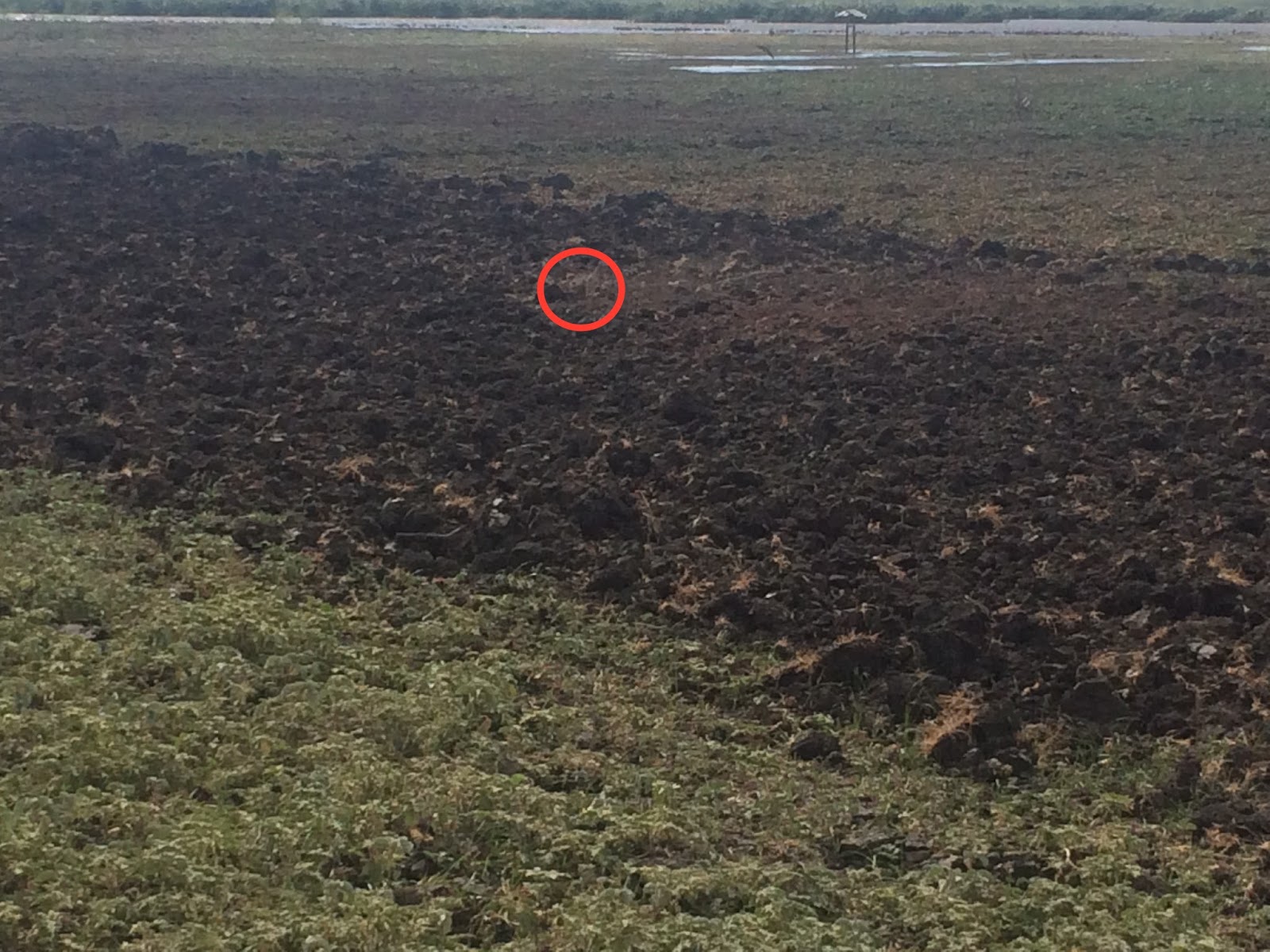
C. similis nesting mounds
It may seem odd to declare the return of a missing iguana through a photo of nesting mounds -- but our best guess is that White-White-Brown, gone since 2/5/16, was off laying her eggs. Her return and sighting today showed us a healthy-looking but thin iguana. Tag intact, attached to her body, solar battery well charged, all is good.

Female digging her nest.


WWBr looking thin yet healthy! 
WWBr
Part of calibration and deployment means attempting to understand how well tags work and endure the natural inclination of C. similis to shove themselves into small rock crevices, dead tree limbs, and all sorts of human-created refuge spots. We now have proof that nest digging does not damage a tag, and that the natural pattern of digging and resting will keep a solar battery charged. Or, at least in the case of WWBr, it works!

Of nine tagged animals, two are male. Of the seven female, two are missing with no tag radio signals. We are hopeful they, like WWBr, will return in good health, simply behaving normally.

Monday, February 15, 2016

Week Four: In which things go wrong...but also right

Yellow-Green-Yellow comes down Big Tree.
By mid-day on 5 February, we had deployed eight working tags on iguanas. A ninth tag, #3 wasn't charging correctly and had to be placed in a lower power mode.

On 10 February, tag #5 on White-White-Brown (WWBr) went Missing-in-Action, along with the lizard. We hope she is off on a great adventure and eventually returns. Her tag send no signal which may mean it is dead, or simply out of range.

White-Orange-Green, the famous WOG of this blog, decided there was little reason to come out and bask for almost a week. We watched with trepidation as her battery voltage drop. Luckily, WOG decided it was time to reappear -- and her battery is charging fine.

Every day we get up before dawn and download logs from the base stations. The logs are the physical proximity encounters between animals, all to understand their social structure. Base stations also record "pings" from tags so we know when and generally how far tag #5 was from any base station when it and WWBr went missing. Each base is managing to successfully "talk" to tags, receive log downloads, and cover a good physical area.

PBKR
 Of course after bringing tag #3 to a good charging level, and spending two days trapping an animal that interacts with the tagged group, Pale Blue-Black-Red (PBKR), our twice daily voltage checks revealed the tag was again not keeping a charge. So, back into a low power mode.

To help understand the data logs, we are processing a number of days by hand. 8 days and ~7 tags is roughly 25,000 lines of tag-to-tag pairs, by day, time, and radio signal strength. It does tell a story!

Monday, February 8, 2016

Week Three: The System is Live!

Base Station location map.
At some point, our testing had to end, parameter decisions needed to be made, and the system to move from enclosed indoor place on to live animals in their habitat.

Base Stations were located near the group of animals we planned to tag and monitor. Two weeks of calibrations, a few days for percolation of plans, and we were ready to collect real data.

Solar Encounternet tag
Next task was trapping eight iguanas -- and luck was with us! We managed a dominant and subordinate male, and six females of varying personalities. Some are bold while others much more shy. The group, tagged in less than 12 hours, went live on 5 February 2016.

Another stream of issues: would the tags stay on the iguanas? Would we see lizards itching at the tags, suggesting they were annoying and changing their behavior?

The tags are powered by solar panels with the expectation that the natural basking behavior of a Spiny-Tailed Iguana would keep them charged -- would they really work that way?

Would the iguanas visit areas near enough to base stations to ensure proximity log downloads?

Will the raw data make any sense?

Like all new endeavors, getting over one hurdle simply means time to get ready for the next mess.

To save battery power, tags enter a "sleep mode" at the end of an iguana day, and the Base Stations follow an hour latter. This is reversed in the morning. I set clocks, download logs, and check battery levels starting at 5:30 am; tags awake at 6:00 am.

For the first week, it's important to see what Bases are being used by which iguanas, and making sure all animals are downloading interaction logs. We are mostly in good shape except for one iguana who does not seem to have come out of a hide in a couple of days. Tomorrow the hunt is on!

Rusty, our dominant male, wearing his tag. 


Monday, February 1, 2016

Week Two: Tags, and Bases, and RSSI, oh my!


Base Station on 3 meter pole with Megan Heier. 
Calibration. Our dear friend Wikipedia offers this explanation: Calibration is the process of finding a relationship between two quantities that are unknown (when the measurable quantities are not given a particular value for the amount considered or found a standard for the quantity). 

I am using Encounternet radio frequency identification tags on Spiny-Tailed Iguanas. When the iguanas are within a certain physical distance of each other, the tags will log their encounters. What needs to be calibrated is the relationship between distance and Radio Signal Strength Indicators (RSSI).

If the RSSI between two tags (soon to be attached to actual iguanas) is -11, how close are they to each other? What about when they are +7 RSSI?

How close does an iguana with a tag need to be to a base station to ensure a power-efficient download of physical proximity logs? 

What height of the base station ensures the above, 3 or 1.5 meters?

When the antennas go in the same vs. opposite vs. perpendicular directions from each other, what does that do to RSSI?

Where should the base stations be mounted?

When should we log tag interactions (wake up call) and when should we stop (bedtime)?

Which iguana sub-group would be useful to test the calibration on real animals? (This is not a trivial consideration -- it would be good to have different personalities, sexes, and perhaps not too many animals that climb 20 meter trees....)

So, we've attached base stations to different height PVC poles, marched tags up and down a measuring tape in the hot sun, taking numerous pages of data. And as explained, RSSI is stronger when off the ground (lizards with jet packs, anyone?), away from concrete and piles of rebar,  and best if antennas are parallel and facing each other.

We have mostly learned how to set controls in the system software, have a good idea of which iguanas will get tags, and are almost ready for a real run.

Rusty, a large male who patrols the open area in the above photo, has more than 8 females in his territory. He also has several second-rank males that he has to address, running them off as needed. The females are bold and shy which should also help test the system and begin to answer the question, why do these non-cooperative animals have the social structure they exhibit?


Wednesday, January 27, 2016

Week One: Census!


Kaplan on the prowl.
Our first field week is over and we're off to a good start. Megan and I arrived in the dark at the Organization for Tropical Studies' Palo Verde Research Station, Palo Verde National Park, after a long travel day on January 18th. We ate a vry late dinner, provided some mosquitos with a meal, and went to bed.

We spent the next day getting our processing lab assembled, settling our rooms, and scoping out resident iguanas such as Kaplan, the largest male at the station. Marked in 2013, he still sports his original beads, Blue-Yellow-Brown. As mating season is in full swing, Kaplan is bold, making important circuits in his home range, chasing off male interlopers, and copulating with females.

Our next reentry into the field is the process of trapping iguanas, checking them for PIT tags, and rebeading if they are a known animal. If the lizard is new, we take standard morphometric measurements, a blood sample for molecular analysis, especially genetic relatedness, and assign a bead code. Important for our work is monitoring the stability of the social group (very) and seeing in what ways an animal has changed its routine, moved refuges, or otherwise is behaving differently than August 2015.  

Rebeaded White-Yellow-Black
 
Since 2013, more than 110 lizards have been caught and beaded in the research station. We track how many new animals we see per day to understand how long it takes to observe a large majority of marked animals. It's a natural expectation that some animals will disappear through predation or emigration. Likewise, younger animals are establishing refuges within certain areas while males are more evident as they seek resident females. Adults males sometimes immigrate into the area. And, lizards move to different refugia within the site.

For example, last July and August, White-Yellow-Black (WYK) used a pipe to sleep in right in front of the OTS office. This trip she is no longer using that pipe and has only been observed in a small woods patch in front of the researcher dorm, about 15 meters away from the office. This may be a temporary or permanent refuge change; we don't know. On the other hand, this is not a large move and WYK is interacting with the most of the same animals from the July-August 2015 observation period. 

When we see a move such as WYK we also try to find the refuge as this is the place where we may quickly check each day to see the animals is still in the group. It's rather helpful that Ctenosaura similis is routinized!


Friday, January 15, 2016

When the semester break began in early December, I thought I would accomplish a good bit of prep and back-burned projects before departing to Costa Rica on 1/18/16. No such luck! While I did visit family for a long weekend, I immediately followed it with a great sinus infection. I then was healthy for SEVEN whole days, presented at #SICB2016, and then caught the flu that I am still fighting. What a rumble!

Given that we leave in just a few days, it's time to get on with all things SCIENCE and Costa Rica! Without further ado, let me introduce Megan Heier, my field assistant for this trip. Megan will help optimize the Encounternet system for use on the spiny tailed iguana (C. similis) as well as numerous other field jobs. This is the first time the system will be used on an iguana -- while the headaches are sure to come, it's also going to help fill in a small part of the secret social lives of lizards, Plus, it's Megan's first time traveling out of the United States -- should be a great adventure for all concerned!

Megan Heier is a junior biology student at UNC.  She is originally from Colorado Springs and has found that Greeley is not nearly as stinky as she always had been told.  She is interested in animal behavior and is exploring her future career options in research. Her hope is to eventually pursue a PhD in biology, but her specific area of study is not decided.  She has only ever met one iguana named Izzy who had a passion for hibiscus and going on walks.  Besides school, she loves taking care of her rats and elderly mouse, watching sitcoms, and spending an inordinate amount of time bird watching.


Wednesday, December 2, 2015

2016: Field Season!

Iguana refugia -- also known as a gutter.

December 1, 2015 -- I am counting down to January 2016, my first long trip to Palo Verde (nine weeks). Along with a field assistant (stay tuned for her introduction in a future post!), I'll be testing an Encounternet System on the iguanas to gather a much fuller social network based on physical proximity.

First we will test how the Encounternet system works at our actual study site. We will simulate iguanas climbing trees, disappearing into dry forest patches, or feeding on open areas. Once we have calibrated the system, a small groups of iguanas will try out the tags in real time, eventually scaling up to a full deployment on 30 animals.

This will be an important window toward understanding how non-cooperative animals negotiate their social lives and is part of the first studying considering the social network in and egg-laying, neotropical lizard.

Saturday, August 1, 2015

Introvert? Extrovert? Ambivert?

 To understand the Spiny-Tailed Iguana's personality, I'm testing them in the field. One such examination is called the Open Field Test (OFT). Its origins reside with the fear perceived by some rodents when they can no longer touch their world -- when they are in the open, likely at greater risk of predation.

Theory suggests that bolder animals will explore the open area more than will shy animals. This makes some sense if you prefer to hug the sides of your world, touching physical objects. In Ctenosaura similis, an omnivore that often feeds in open areas, how useful is the OFT to measure fear -- and is there a statistical difference between bold and shy iguanas in their exploration of the OFT arena? Does Bold Pale Blue-Black-Red (PbKR) explore the arena more than shy Brown-Red-Green (BrRG)?
PbKR: Bold

BrRG, on tree roots near the pergola. A very shy iguana.
 To begin to answer that question, I constructed a 10' x 10' testing arena, seen below, and rigged a digital video camera on the station ladder to record 10 minutes of exploration per animal. I use an imaging tool to superimpose a grid on the area and score how many times an animal crosses the grid as well as other behaviors (jumping up sides of the walls, attempting to climbing the ladder, sitting, etc.
Open Field Testing arena with tripod on ladder to digitally record test.
It may be that bold and shy animals have similar levels of exploration because the OFT is not a good test of fear in this species. They may all be equally irritated from the loss of a visual field and spend energy searching for an escape route. While it would be fruitful to have personality tests that work for all taxa, this strikes me as unlikely -- especially in an animal that often feeds in an open field!

White-Orange-Green (WOG) grazing on the lab lawn (open field).

Wednesday, July 22, 2015

My How You Have Grown!

Black-Black-Green (KKG), fondly called Keg, was first captured 24 December 2014. He weighed 250 grams, and measured 15 cm from snout to length of his body. His full tail was 34.6 cm in length.


On 21 July 2015, I recaptured KKG. He only has 7.3 cm of original tail and 12.3 cm of regrown tail -- did he survive a predation attempt or did he injure the tail in some manner? His Snout-to-Vent length is now 20.4 cm and he has gained 350+ grams of weight. You can see how my hand is holding a much larger iguana than in December!


Keg is growing quickly. He has survived the perils of being a tiny hatchling predated on by almost every other animal. He is still living in the same general area, using the office roof for a refuge and feeding on the lawn in front of the lab. And he is interacting with iguanas larger and more experienced than himself.


Tuesday, July 21, 2015

How dry is it?

When I use fruit to bait the iguana traps, I may instead catch a capuchin monkey or a coati. This year the rains are very late, the soil is crunchy, and the leaves are wilted on the trees. 

Here is a begging capuchin who followed me on hopes of food. While they do raid traps, this is not typical in the station. 

And here is a male coati who also raided one of the traps:

I won't bore you with the raccoon;  or that this post was delayed as I needed to release another monkey from another trap. When a troop is around, trapping stops. 

Below is a yearling iguana ignoring small trap while WWW goes for the big trap -- she was rebeaded and I took a blood sample for the molecular part of my dissertation:


Sunday, July 19, 2015

Find the Iguana: Pochote

Spiny-Tailed Iguana can climb a tree called the Pochote. The tree spikes are huge and sharp but no worries for an C. similis!
Can you find the iguana?

Now?

Spiny Pochote Tree
Here is a good description of the tree: http://guanacastecostarica-mitierra.blogspot.com/2012/05/costa-rican-forests-pochote-tree.html

Saturday, July 18, 2015

Day Uno

Piercing an iguana's nuchal crest to add colored beads is a time-honored technique to mark individual animals. To use social network analysis tools, individual ID is a must. However, iguanas of all sorts are fascile in removing said beads -- so every trip begins with a few trapping days. 


It's quite interesting how willing Ctenosaura similes is to enter a trap for some fruit. In this very end of dry season (rains are late), fruit is likely an amazing food find. 

Also, iguanas are both disappearing and new ones join the group -- so in the 16 caught during my first full day, 4 are new to the study. Known animals are generally more useful for my questions about social structure and usually they are where I expect them to be -- same local area, same refuge and previous 6 months. Stability is important for this species.  

Breakfast for humans is 6:30; by 7:30 all traps are set and baited, and I wait for the iguanas to warm up enough to start their day. In the meantime there are the howler monkey and parrot seranades, the mosquito attacks, and the great pleasure of field work. But don't get me wrong: it's all for SCIENCE!


Friday, July 17, 2015

Vanity? No! Safety!

A large male caught today managed to give me a nice bite. Yes, iguanas have teeth! I was wearing gloves but he managed to grab my wrist. Lucky, Fitbit took the brunt, iguana processed in under 15 minutes, and within hour, out grazing again. A good day!

Wednesday, July 15, 2015

Iguana Toast Chronicles will not kill you!


FID, NO, OFT

Not diseases but in situ personality testsfor animals: Flight Initiation Distance, Novel Object, and Open Field Test.

Monday, July 7, 2014

Green is the New Dry....

In the sense that since arrival, and many days beforehand, there has been no rain. Palo Verde looks like my Colorado home in the summer: green but on the edge of yellowing out from lack of rain and copious sunshine.
New ~2 year old C. similis.

Still green enough to eat!

This trip is short and simple -- trap iguanas, collect blood, collect parasites, and try out network analysis data collection protocol. Trapping comes first as the animals must be known as individuals to create the network.

I've spotted most of my known animals -- always a fear that they have absconded in my absence and a huge relief to see that was a false worry! However, there are a number of new animals that must be added to the network.

I won't join the marked animals until I live at least another year!
Lack of rain is detrimental to Palo Verde -- but behaviorally, iguanas are doing much the same as they also do -- up and active when the sun is out, and siesta during cloud cover. At least some things are predictable!