Thursday, January 2, 2014

Resistible Trampa! or, Love is in the Air....

How do I catch iguanas? With a good old humane wire trap. Each day after breakfast, I 'steal' fruit from the morning's platter -- pineapple, or papaya, or bananas, or watermelon -- they are all good for enticing a black iguana into a trap. But it's not fool-proof. Sometimes there is simply too much activity near the trap, or the commotion has sprung the trap empty.
Female coming down Big Tree captures male's attention.
 Other times the lovely female nearby is far more interesting than fruit. The next few photos show a smaller male (eventually caught, beaded, and PIT tagged) showing his beauty to a not-completely convinced female, WOG. Interestingly, he displayed as if ready for battle -- lateral compression, elevated on his legs, colors very pastel. Can't you see how big and beautiful I am?!!

She soon gave the male a low-key whip with her tail. Not the tail strike that could communicate "Not even if you were the only male on a deserted island," but one that suggested, "Not yet -- try me again in a few weeks." It is, after all, only the beginnings of mating season. Courtship has its purposes!
Male displays and approaches female.

First female leaves but second female comes down and the male is all eyes.
 The male gets another try with a second female who comes down Big Tree.
His display is acrobatic!

He even gets a leg on her body....but she soon gives him a "no-go" tail whip.

Monday, December 30, 2013

This is MY space -- or perhaps I don't care much about it....

Patterns of Interactions
Each time I'm at Palo Verde, I watch the spatial pattern of animals, where they are physically located, and the places they use in their day. I observe the animals and their interaction (and try to understand why).                                                                                                                                                        
Kaplan
Animals may move for their own reasons; sometimes we may contribute to the relocation. Blue-Yellow-Brown (Kaplan) most often used a roof hide on the dining hall end of a building. But a roof leak necessitated repairs and he since moved to the opposite end of the building. Not a huge change by any means. Charcoal made the same shift and Miami uses a roof refuge very near Kaplan. They all stick their heads out in the morning and watch as we go into breakfast.

Two iguanas on branches
 In Big Tree, most of the iguanas are the same individuals observed in May. Physical movements from one refuge to another seem to be in terms of >100 m, most often >20 m.

Ctenosaura similis is described as a territorial species -- but rarely does an author define the meaning of territorial behavior. Sometimes we call the males 'resource polygynists' which tries to indicate that the males guard resources females find important. I have yet to see this in operation. (I can wholly see males guarding females from other males during breeding season -- but if they are guarding female resources at other times during the year, it's subtle beyond my means!)

Maher and Lott (1995) propose this definition of territoriality: a fixed space from which an individual or group of of mutually tolerant individuals actively excludes competitors from a specific resource or resources (1). Sounds good -- but I want to understand and better define the temporal patterns of territoriality. How often is an iguana actively excluding others from that important resource? How much time is spent on the exclusion behavior? If duration and frequency is minor compared to other activities of daily life, is territoriality an important illuminator or descriptor of Ctenosaura similis behavior? At present, I'm not convinced territoriality is the indisputable epicenter from which C. similis behavior springs.


(1) Maher, C.R and D. F. Lott. 1995. Definitions of territoriality used in the study of variation in vertebrate spacing systems. Animal Behavior49, 1581-1597.

Monday, December 23, 2013

My, How You Have Grown!

Am I really bigger?!

Have I really been gone from Palo Verde National Park for 6 months? In my absence, the OTS station was abuzz with changes, for humans and iguanas alike.

Pale Blue-Black-Red (Pb-K-R) has more than doubled in weight. If not for the beads, I wouldn't have recognized him! He also moved from the lab near Green-Green-Green to the Big Tree area near to White-Orange-Green.

Many other iguanas are larger, growing throughout the green (rainy) season. Adults look good and plump. This is day 2.5, and we are still rounding up the lizards (thank you, humane traps and bananas), but 19 of 53 are present and we expect to approach near 100% recapture by trip's end. We've also caught 3 new lizards.

For humans, buildings have received a fresh coat of paint, outdoor showers have been added, and the entire laundry area is shaded for staff, a great improvement. Faces are familiar and food is still good! Dry and cracked in May, the wetlands are full of water with incredible numbers of birds and and a few visible crocodiles.

Six of the 60,000,000 Black-Bellied Whistling Ducks at Palo Verde!

Am I Adapted to My Environment?


Am I Adapted to My Environment? Yup -- or you wouldn't be here!

When I think of environment, I often think of food, shelter, and weather, and oh yeah, behavior. Isn't behavior in service to the needs of foraging, avoiding predators, thermoregulation cycles? Well, yes, or at least, perhaps. But how is your behavior adapted to your environment? Doesn't your environment include conspecifics? In what ways do spend your time so that you learn and survive?

Behavior, especially interdependencies between individual animals, can have as much effect as good forage, appropriate refugia, and preferred optimum temperature zones. Individual behavior, then, should be adapted to the social structure in which an animal lives. Even in a non-cooperative animal like Ctenosaura similis, an understanding of which same-species animals might be a danger, or useful, or neutral might well tip the balance between surviving and thriving, between some offspring, and overall better fitness.

So, yes, you are adapted to your world!


Wednesday, December 11, 2013

Dynamic Networks


Today, this iguana fondly known as Blocky, is here, tomorrow he will be over there, the next day somewhere else...and so on. As for all the iguanas, the network structure I'll build through physical proximity will suggest a static set of interdependencies, when in fact relationships may change seasonally (wet/dry, breeding/nonbreeding) or at other temporal scales.


Territoriality itself could change. C. similis is a central-place territorial holder focused on a refuge. At that location, an iguana may chase off conspecifics while when foraging at a different location, appears to give no thought to the refuge presently undefended or the iguanas now tolerated.

Humans are also central-place territory holders -- we want to sit in 'our' seat in a classroom, feel possessive of it, but never give a thought to who occupies it next once the class is over. Our possession, like the iguana, is contextual. 

Sunday, December 8, 2013


Ah....just 12 days and I'm back to Iguana Toast Land, where Ctenosaura similis roam free, and the average temp must be greater than my current 7 degrees F!

Since May, I've completed the first semester of my doctoral degree, taking courses, attending seminars, reading more papers than I'd like to count, and getting a research grant from my university. While every moment has not been 100% successful, the challenges have been rewarding in very good ways.

Still, I want to keep my research and thinking steeped in field situations. I see the sheer do-ability of lab organisms, but suspect I am better suited to the challenges of in-situ projects. For 15 years, I've had the honor observing I. iguana in a captive group, and during that time, numerous occasions to observe endangered wild iguana species. They are captivating, physically attractive, socially complex, exciting animals. In the case of C. similis, they are observable and often tolerate living among humans. I'm always thrilled I get to see this incredible animal live free, and to attempt to understand the basis of its social organization.

This trip I'll have along one of my favorite field colleagues, my husband. We will catch and process iguanas, explore Palo Verde National Park, and spend Christmas in the neotropics. He'll see my study site, the cast of iguana characters, and help open my second study population.


I'll be posting throughout the trip and beyond -- stay tuned!

Friday, August 2, 2013

The 5th Dimension


My head feels awash in neurogenesis -- surely five days at the Animal Behavior Society's conference in Boulder has initiated new brains cells!

I attended a good behavior and conservation workshop, attempting to find solutions to four real world, sticky problems. It reminded me why my own research feels a great refuge from such messes. Yet basic research, and perhaps especially understanding animals in their own world, could save us from so many calamities before they begin. But that's another day.

I'm humming about social networks and the insights I gained during the conference -- everything from how connections suggest certain group and individual attributes to data collection goals.

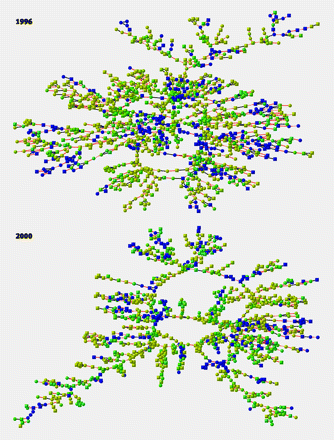
The origins of social behavior are not in cooperation (provisioning young, dueting, chasing away predators) but, more likely, simple tolerance. Not a a gaggle of geese but an aggregation of iguanas. The members of the aggregation are connected to each other, perhaps in 'neighborhoods' -- each member knows a subset of the entire group, just like a group of people who are Facebook friends. (I'm the big red dot in the middle and you can easily see neighborhoods.)

Social networks suggest interesting questions related to personality, behavioral syndromes, learning, parasite load, and fitness (meaning who produces the most offspring who produce the most offspring).

For example, if an animal is bold toward potential predators, does the animal also have many connections to other animals in its group, and does that predict who the animals learns from and its parasite load? Does a young female iguana learn the best nesting site from the most connected iguana in her 'hood? Are the neighborhoods assemblages of related animals? Or are neighborhoods avoiding inbreeding and making sure the mix of animals are unrelated? An how do those layers operate to produce better or poorer fitness? 

While the iguana may look like it has no preferences, no likes or dislikes (let's not forget iguanas do not have facial muscles so their lack of 'smiling' isn't terribly revealing), for all we know the aggregation is a powerful kin or even fictive family. 

The chessboard base is the social network: individually known iguanas, their attributes, and their connections. And then there will be a relatedness dimension. And personality. And so on...let the sunshine in!